Ochlocracy
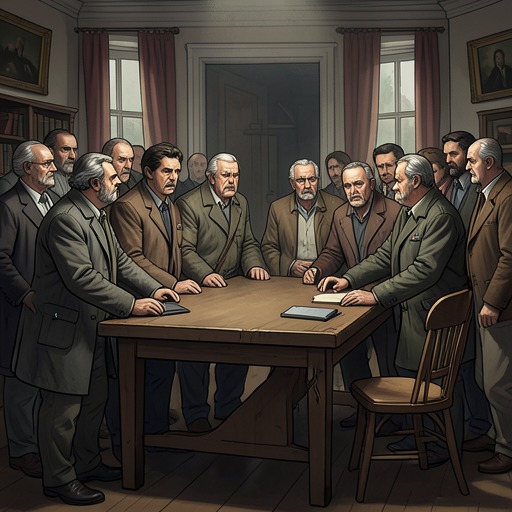
The Social ContractOchlocracy is Rousseau’s name for democracy in its degenerate form: the abuse of government that follows the dissolution of the state. Its significance lies in the distinction it draws between popular sovereignty, grounded in a common will and law, and a disorderly political condition in which the institutions meant to serve that sovereignty have broken down.
Definition and Place in Governmental Decay
Rousseau places ochlocracy at the end of a process that begins with tension between particular and general wills. Government, he argues, continually exerts itself against the Sovereign; as that pressure grows, the constitution changes, and the government may eventually suppress the Sovereign and break the social compact. This tendency belongs to the body politic from its beginning, as aging and death belong to the human body.
Governmental contraction and the dissolution of the state are related but distinct developments. Contraction is government’s movement from the many to the few—from democracy to aristocracy, and from aristocracy to royalty. Dissolution occurs when government usurps sovereign power or when its members seize individually the authority they should exercise only together. The resulting failure of the state is what Rousseau calls anarchy in the general sense of governmental abuse; ochlocracy is its specific democratic form.
The Compact and Popular Sovereignty
The contrast with legitimate popular rule is essential to the term. The social compact is meant to establish an association that protects each member through the common force while allowing each to remain free. Its clauses rest on the total surrender of each associate and all their rights to the community on equal terms. The compact also provides that anyone who refuses the general will may be compelled to obey it, a condition Rousseau presents as necessary to make civic obligations effective and to secure citizens against personal dependence.
In the civil state, liberty is not simply the unrestricted ability to pursue whatever an individual can obtain. The compact exchanges natural liberty and an unlimited claim to whatever one can seize for civil liberty, limited by the general will, and property grounded in a recognized title. Obedience to a law citizens prescribe to themselves is, in Rousseau’s account, compatible with freedom. Ochlocracy therefore cannot be equated with popular sovereignty merely because both invoke the people: sovereignty belongs to the general will, whereas ochlocracy marks the collapse of the state that should give that will political form.
Scale, Institutions, and Political Conditions
Rousseau’s account of government also connects political stability to the scale and composition of a state. A state can be too large for good government or too small to maintain itself; extending the social tie relaxes it, while long distances multiply administrative layers and costs. He further argues that territory and population must stand in a fitting relation: land should sustain its inhabitants, and the population should not exceed what the land can maintain. Excess land is difficult to guard and may encourage defensive wars; insufficient land can create dependence on neighbors and provoke wars of offense.
Within these limits, Rousseau offers a general correspondence between the number of supreme magistrates and the number of citizens: democracy tends to suit small states, aristocracy those of intermediate size, and monarchy great states, though circumstances can produce exceptions. These propositions do not define ochlocracy, but they establish the institutional and material setting in which a government must preserve the state. The term identifies a breakdown, not a constitutional form Rousseau recommends.
Historical Illustration and Significance
Rousseau’s discussion of Rome illustrates how political arrangements respond to the makeup of a community, without identifying Rome’s early organization as an instance of ochlocracy. After Rome’s foundation, its army—composed of Albans, Sabines, and foreigners—was divided into three tribes, each subdivided into ten curiae and then into decuries. Each tribe also supplied a hundred knights, a division that suggests these arrangements were initially military. As the foreign population grew, its tribe became stronger than the Alban and Sabine tribes. Servius changed the organizing principle from ancestry to residence, creating four tribes identified with Rome’s hills and preventing residents from moving between districts so as to keep the racial groups from mingling.
This institutional episode sits beside Rousseau’s broader distinction between the formation and preservation of political order and its degeneration. Ochlocracy is not the people’s direct participation in lawmaking: Rousseau argues that sovereignty cannot be represented, that deputies are only stewards, and that a law not personally ratified by the people is null. The term instead names democracy after the state has dissolved. It thus marks the boundary between popular rule as an expression of sovereignty and disorder as the consequence of government’s failure.